

Reflections from digital capabilities and cultures
Welcome to my reflective blog, a space dedicated to exploring the dynamic world of primary education. Here, I share insights, experiences, and thoughts, particularly on the impact of technology and navigating the digital environment. This platform is designed for fellow students to engage with my reflections and provide valuable feedback as part of my university assessment journey.

Blog #1
'Has technology made me a better learner, or has it simply made learning more convenient?'
Throughout high school the use of technology was limited to laptops that were supplied by the school and only utilised in some classes, never consistently. In comparison to currently studying ten years after high school, where the use of technology has increased astronomically.
When I was in high school technology played a minor role, where my learning occurred through face to face, handwritten work and physical textbooks. Whereas my university degree, now ten years later, is almost entirely digital. Our learning materials are accessed online, assignments are submitted digitally, we rely on the internet for finding our academic sources and an increasing use of AI tools in the learning environment.
Upon reflecting on my experiences, it has me questioning whether I am becoming a better learner for it, or am I relying on it for more efficient, easier ways to complete a task. Having now researched the impact of technology on us in more depth, I do believe that it has become a thing of convenience for myself whilst simultaneously enhancing my engagement and understanding of content, due to how easy it is to access information.
I believe there was advantages to both phases of my learning. Relying more so on memory and effort in high school, versus, more flexibility in university, quick access to materials/lectures. Although, this has come at a cost where it has significantly reduced the need to struggle or think independently.
There’s no doubt technology has been beneficial for my current university degree, with access to AI and online resources making learning and accessing content efficient. My experience from high school to now is reflected well by, Timotheou et al. (2023) who argues the impact digital technologies has on education, directly depends on how it is implemented. So, yes, I may have more access now, but does that mean I am necessarily a better learner for it? This made me question the idea about ‘better learning’ more closely. Wu (2024) conducted a meta-analysis assessing the relationship between digital technology and deeper learning. He described deeper learning as not just memorising content but rather genuinely understanding, connecting ideas or applying new knowledge to other situations. This helped me to understand why teachers put so much emphasis on not relying on it. Rather we use it for support to enhance deeper learning and understanding of content.
I believe in my experience technology has overall made learning more convenient, and when used purposefully it has been an invaluable source to my education. Although, it has made me aware of the point that having access to technology doesn’t automatically equate to being a better learner.
In the future, I want to be more conscious of the ways in which I reach for technology and not rely on it as heavily. Instead, utilising it for clarity of concepts, finding information and enhancing my understanding of material. Therefore, I can benefit from the convenience of technology whilst also maintaining a deeper understanding of the information I am accessing.
References
Timotheou, S., Miliou, O., Dimitriadis, Y., Villagrá Sobrino, S., Giannoutsou, N., Cachia, R., Martínez Monés, A., & Ioannou, A. (2023). Impacts of digital technologies on education and factors influencing schools' digital capacity and transformation: A literature review. Education and Information Technologies, 28, 6695–6726. https://doi.org/10.1007/s10639-022-11431-8
Wu, X.-Y. (2024). Exploring the effects of digital technology on deep learning: A meta-analysis. Education and Information Technologies, 29, 425–458. https://doi.org/10.1007/s10639-023-12307-1
Blog #2
'What are the benefits and risks of living and learning in a digital environment, and how are schools supporting students to navigate this digital world?'
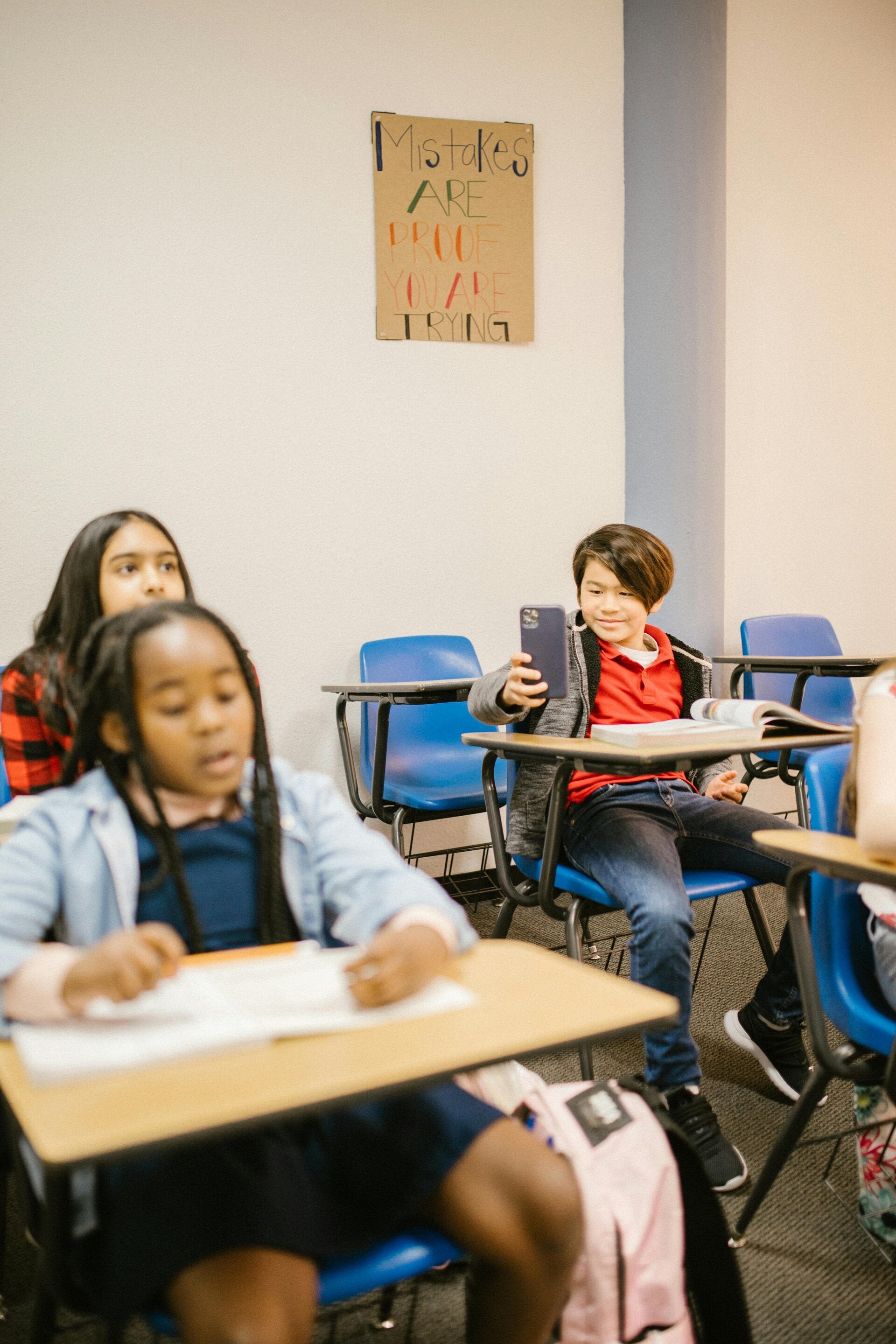
As technology continues to develop, students need to navigate digitally dominant environments. There is an abundance of benefits to living in this digital environment, and children’s digital literacy has advanced significantly. However, from my experience in high school, online incidents like cyberbullying are prevalent and I would argue that children may not have grasped these associated risks.
My perspective on technology has shifted slightly as I’ve gotten older, as my experiences have shaped and changed my view. Throughout high school I was unsuspecting of the potential risks associated with the digital environment until an incident arose where students created a Facebook page of ‘the best looking’ sparking a school wide ban on the use of Facebook in classrooms. This experience was the first of many negative cyberbullying related incidents to come and understandably many students were excluded and hurt in the process. However, amidst my experiences, I also heavily relied on technology to communicate with my best friend that moved overseas.
Technology is in no doubt an incredible tool, not only for access to information but also for communication, personal expression and being able to maintain long distance relationships. Technology provided me with the opportunity to keep in close contact with my best friend throughout high school, which I couldn’t have imagined what it would have been like without access to it. Mersiovsky (2025) elaborates on the many opportunities’ technology provides for communication between peers, social connection and self-expression/presentation. This highlights how technology can be purposefully used in a beneficial way as a creative outlet for students as well as a platform for accessing information and communication. In my experience without such access, I would have had less contact and believe my relationship would have suffered.
However, I also saw how detrimental technology could be to students’ mental health by witnessing such experiences. In a recent review, the Australian government (2025) reported that 20% of young people under the age of 18 experience online bullying in any given year. Initially looking back on the Facebook incident, I viewed it as students behaving inappropriately online but didn’t give much thought to it at the time. However, Campbell & Xu (2022) explores a very good point that many students are unable to distinguish the formal definitions of bullying and cyberbullying to real life situations. This makes me question whether the students creating the group understood the impact and seriousness of the situation.
The shocking prevalence of online abuse in young adolescence is why we need to question, what are schools doing about it? And how are we to support young students navigating this digital world? Since technology has many benefits to learning, rules and regulations around online activity and cyberbullying needs to be heavily monitored. Through my observations and further research, I believe more explicit teaching of the potential risk/ harm of technology is vital.
In my future practice I hope to minimise these risks by implementing explicit teaching of how to safely navigate/ communicate online. Additionally, I would continue utilising digital technology within classrooms due to its major benefits, but I would be monitoring more closely what students have access to through the schools’ content filtering system.
References
Campbell, M., & Xu, J. (2022). Children and adolescents’ understanding of traditional and cyberbullying. Children and Youth Services Review, 139, 106528. https://doi.org/10.1016/j.childyouth.2022.106528
Department of Education. (2025). Final report from the Anti-Bullying Rapid Review. Australian Government. https://www.education.gov.au/antibullying-rapid-review/resources/final-report-antibullying-rapid-review
Mersiovsky, A. (2025). Risks and benefits of social media for children and adolescents. Pediatric Nursing, 51(4), 181–198. https://doi.org/10.62116/PNJ.2025.51.4.181
Add comment
Comments
This reflection is very effective and engaging, particularly because of how you connected your personal experiences of the benefits and risks of digital technologies. I particularly liked your example of the Facebook page, as it effectively portrays the real-world impact cyberbullying can have on students. Your experience of using technology to maintain a long-distance friendship provides a strong and clear contrast which shows that technology can have both positive and negative effects on students. The use of Campbell and Xu (2022) greatly strengthens your analysis as it encourages you to question whether students involved in the incident understood the seriousness of cyberbullying. To strengthen your reflection further, I would suggest expanding on how schools can support students in navigating digital environments and let them know the severity of consequences of cyberbullying. Additionally, your action plan could explain more specifically how you would teach online safety in your future classroom. Overall, your reflection effectively combines personal experience and research, with further focus on schools’ responsibilities making it stronger.
Connect with fellow students
These blog posts are designed to foster discussion and critical thinking among my peers. Your insights are invaluable for my university assessments and contribute to a richer learning experience for everyone. Please feel free to leave your feedback and engage with the topics presented.
Add comment
Comments
I really liked your blog as it reflects your experiences of technology in high school and university very detailedly. This personal reference is what made your reflection engaging and demonstrated how technology has since changed. Similar to what I wrote about in my own blog, you also believe that greater access to technology does not necessarily make someone a stronger learner which I like.
After reading your blog, it makes me wonder about the potential learning activities where you believe technology improves your deeper understanding in comparison to activities where traditional methods seen in most classrooms may be more effective.
An area for improvement would be how you touched on the use of Ai as a tool. You mentioned that classrooms should increase the use of AI tools but how would AI specifically develop thought or understanding within the classroom. By linking this deeper connection into classrooms would support your argument and make your reflection more relevant to digital learning.